
Note-taking takes way too much time.
Documentation is a top driver of therapist burnout (Tebra, 2025), and the standard advice is type faster or stay later. We think that's a stupid fix. You should be reading notes and signing them, not writing them.
We make note-taking effortless.
Two clicks and a signature. That's the workflow.
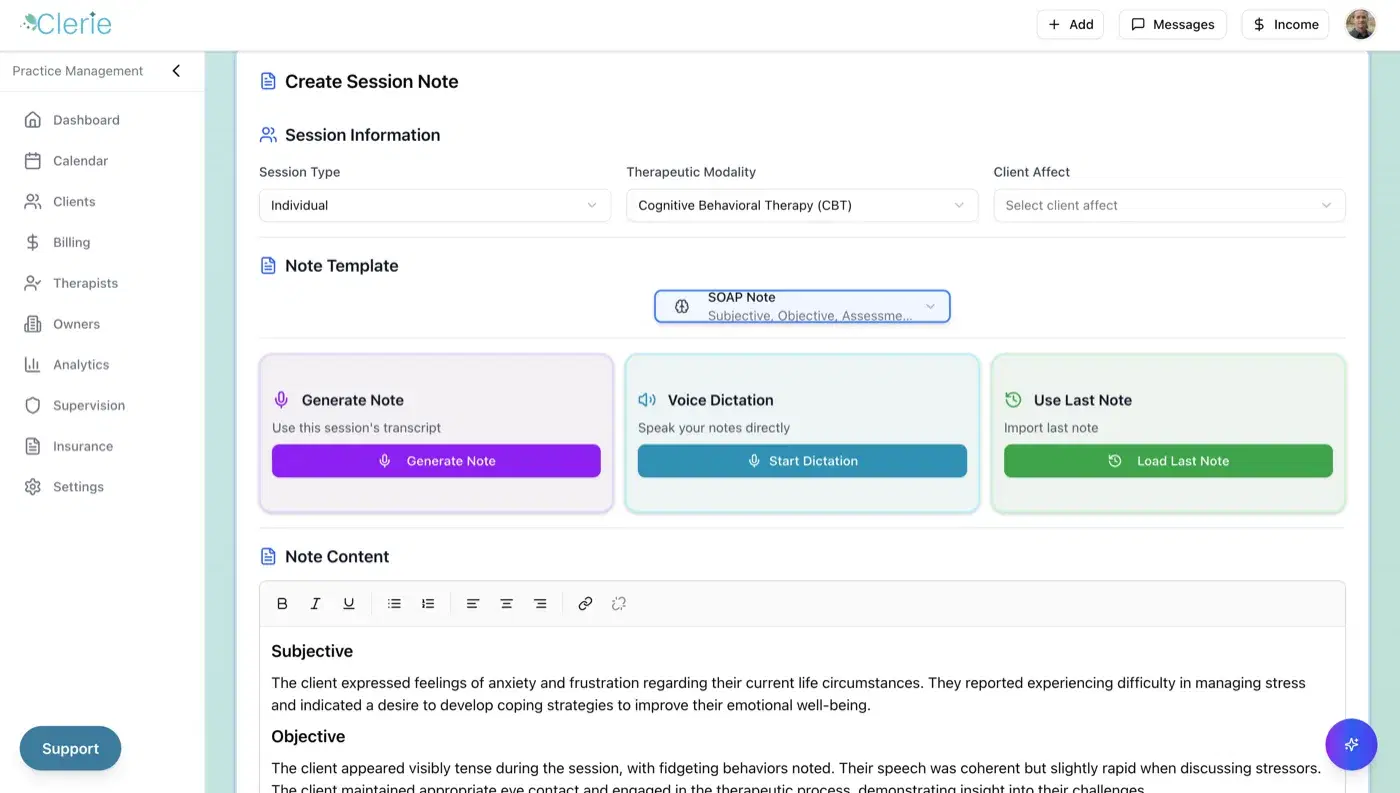
Record the session, get the note
Hit record in person or inside a Clerie telehealth session, click finish, and the note is drafted by the time you sit back down. If you run bilateral stimulation for EMDR, the duration and number of passes are factored in too.
SOAP, DAP, or your own template
The note drafts in the format you already use: SOAP, DAP, or a custom template you built yourself.
Treatment plans and safety plans too
The treatment plan drafts from the diagnosis and presenting problem, written insurance-friendly so the plan itself doesn't trigger a denial, and the safety plan pulls from homework, past sessions, and that plan.
More than the note
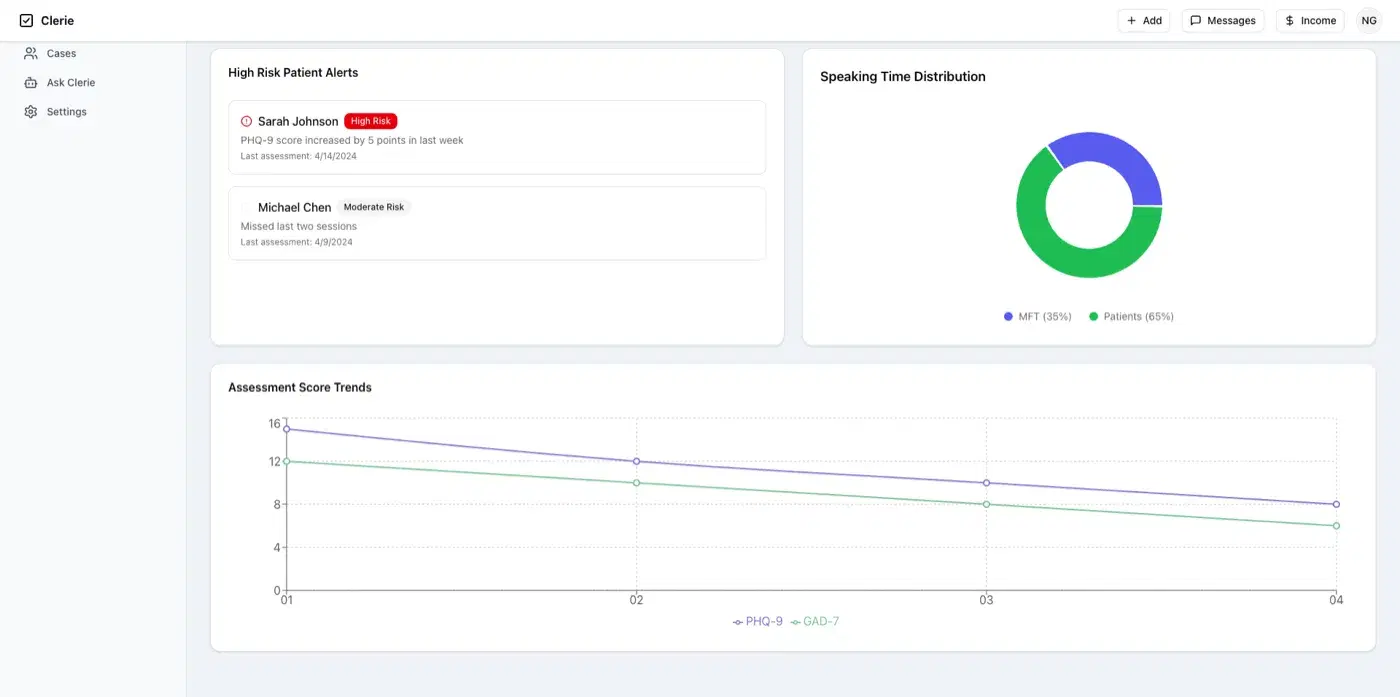
Risk gets flagged to the supervisor
Harm language, suicidality, or a spiking assessment score raises an alert to the supervisor on its own; the AI was built with high sensitivity to self-harm.
One note for the whole group
A 10-person group session becomes one drafted note that you review once and apply to everyone.
One note, ten charts
Applied to 10 clients
It drafts your treatment plans and safety plans too.
- Progress notes drafted from the recorded session, in person or telehealth
- Bilateral stimulation for EMDR: duration and pass count land in the note, at no extra cost
- Treatment plans generated from the diagnosis and presenting problem, insurance-friendly
- Safety plans that pull from homework, past sessions, and the treatment plan
- Risk alerts sent straight to the supervisor on the sessions that matter
- Group notes: one note, applied to up to 10 people
- Private psychotherapy notes kept outside the official file, not discoverable by insurance
- Zero client data used to train AI. Ever.
ReplacesTwofold · Standalone AI note-takers
Looking for intake forms and consent signatures? Those live in Scheduling & Onboarding.
Therapists get 6+ hours back every week.
We threw out a stat we couldn't verify. This one held up.
6+ hrsback per therapist, every week
“Look and functionality are clean and simple, easy to use, saves me time.”
What Should You Look for in Therapy Practice Software?
Therapy practice software is usually evaluated first on scheduling and billing, then documentation, but for a growing insurance-based practice, that can change. A note that doesn't connect to the rest of the chart, the claim, or the video session creates an additional task for someone else on staff. Clerie's clinical documentation software runs inside the same HIPAA-compliant EHR as telehealth and insurance billing, so a session on either drafts the note automatically, and a signed note then moves into the claim.
For a practice with dedicated billers or front-desk staff, that's the difference between an EHR for therapists built as one system and a standalone therapy notes EHR that only handles the note.
What SOAP And DAP Stand For
SOAP breaks a session into four sections: Subjective, Objective, Assessment, Plan. DAP condenses that into three parts: Data, Assessment, Plan. Clerie's therapy notes app drafts in whichever format a practice already runs. Our customizable therapy note templates extend that to offer a couples-intake template, an EMDR template, or any format a clinical director has already standardized. If you run Clerie's bilateral stimulation tool in that session, the duration and number of passes are factored into the draft too.
Practices migrating from SimplePractice, TherapyNotes, or Valant can import an existing template into Clerie's therapy note writing software instead of rebuilding it from scratch.
Building a Treatment Plan and a Safety Plan
A treatment plan needs goals, objectives, and interventions tied to the diagnosis worked out in session. Clerie's mental health treatment plan software generates a preliminary version of all three components, allowing the clinician to edit specifics rather than starting with a blank form.
A safety plan is based on warning signs, coping strategies, support contacts identified by the client, and established goals. Both carry clinical weight, so neither becomes part of the record until it has been reviewed and signed.
Group and IOP Sessions, Charted Per Client
Group therapy and IOP cohorts document differently than one-on-one sessions. The clinical narrative is shared, but attendance and individual progress still need to land in each client's own record. Clerie's AI therapy notes carry that narrative into every attendee's chart automatically, so a DBT skills group doesn't turn into a separate write-up per person.
See how that ties into claims for group codes on the Insurance Billing page.
Private Notes Kept Separate From Shared Records
Process notes and private psychotherapy notes serve a different purpose than progress notes. Clerie keeps that content in a separate section of the record by design, so it isn't part of what a co-treater or supervisor sees by default.
Supervisor Risk Alerts, Across a Growing Team
A note that mentions harm, risk, or a concerning assessment score reaches the supervisor dashboard without anyone flagging it by hand. For a supervisor covering clinicians across two or three different locations, the alert doesn't depend on which office the session happened in, or whether they happen to open that chart that day.
Explore how that fits into oversight on the Clinical Supervision page.
Book a Demo
Clerie's AI clinical documentation software for therapists covers more than progress notes. Insurance-based practices, growing group practices, and multi-location behavioral health clinics can use Clerie's therapy practice software to standardize how every provider charts.
The questions people actually ask on demos.
Stop doing notes after hours.
Book a demo, bring a real session, and judge the note Clerie writes against the one you'd have written at 9pm.
A 30-minute call with our team. We'll show you the note, the treatment plan, and the safety plan live.