
Sunday, November 16, 2025
Why More MFTs Are Turning to Measurement-Based Care—And How Clerie Makes It Easier Than Ever
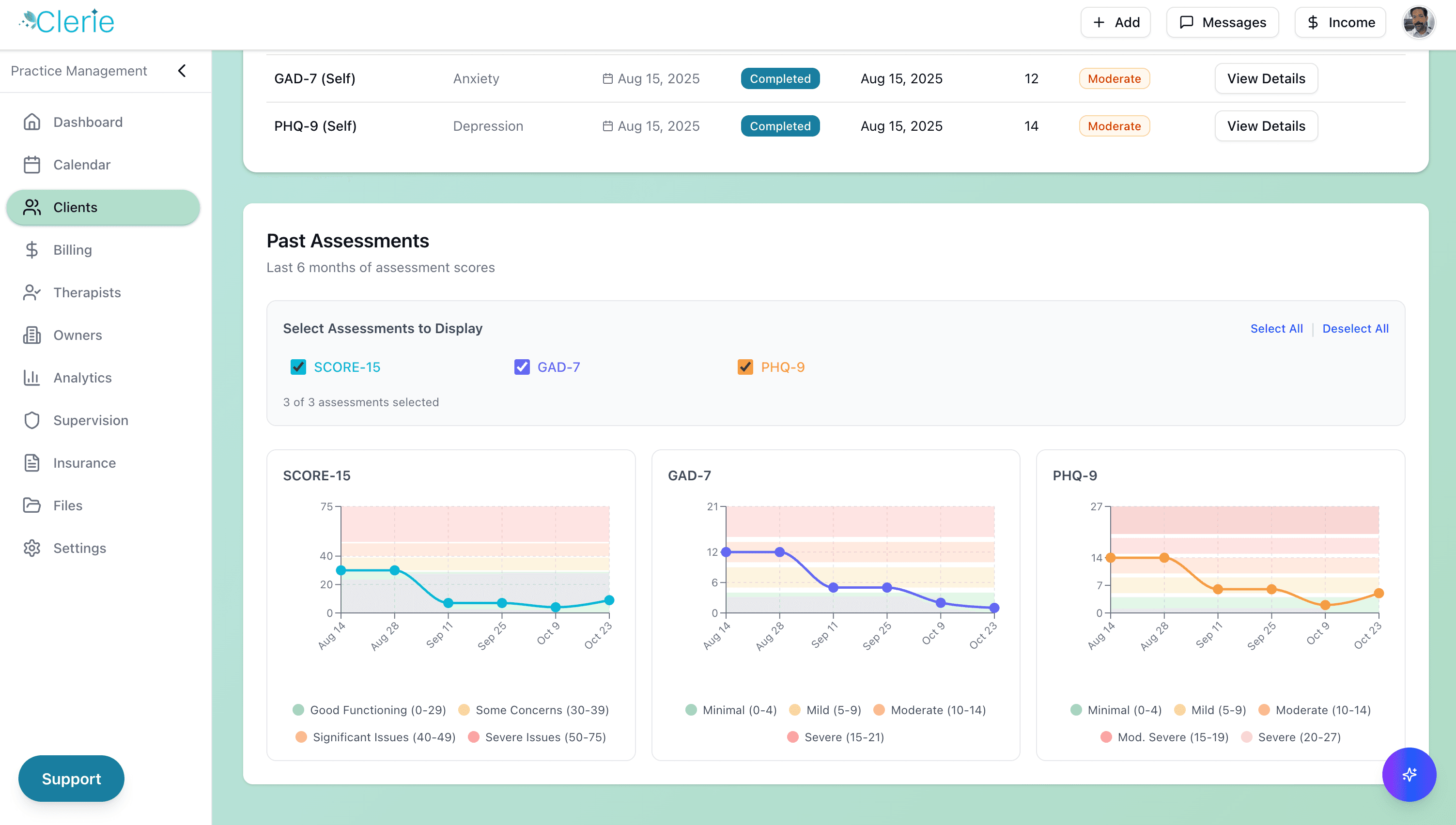
However, implementing MBC consistently is another matter. While the research is clear, the actual workflow—finding the right assessments, sending them to clients, gathering results, integrating them into progress notes, and using them to guide treatment planning—can be an exhausting process when done manually. Many therapists quietly admit they want to use more measurement tools but simply don’t have the time, tools, or support to make it happen.
That’s exactly the problem Clerie set out to solve.
The Rise of Measurement-Based Care in Family Therapy
In the past decade, mental health as a whole has moved toward data-supported treatment. But for MFTs in particular, MBC is becoming essential. Insurance companies have tightened their expectations around medical necessity, treatment progress, and outcome documentation. Agencies and supervisors are also pushing clinicians to incorporate standardized tools to ensure consistency and quality across cases. And clients—especially younger generations—are increasingly receptive to seeing charts, patterns, and data about their emotional progress.
Research has shown that MBC not only reduces dropout rates but also increases the likelihood that clients will remain engaged through difficult stages of treatment. For family therapists who often navigate complex push-and-pull dynamics, having tangible indicators of progress can bring clarity and calm to sessions that might otherwise feel emotionally overwhelming. Even simple measures, repeated regularly, can empower couples and families to see their relational patterns in a new light.
Yet many EHR systems were never designed with the realities of family systems in mind. They assume a single client, a single assessment, and a one-directional workflow. MFTs know that’s rarely how therapy works.
## Why MFTs Need Multi-Perspective Data—Not Just One Assessment Per Case
A couple’s conflict is never experienced the same way by both partners. The same is true for a parent and teenager, or two co-parents navigating different households. One person may feel unheard while another feels overwhelmed. One partner might see increased harmony while the other still feels tension. Capturing these differences is essential not only for setting treatment goals but also for tracking whether those goals are being met.
Traditional EHRs treat each case as a single user: send one assessment, get one result, and store one score. But for MFTs, this approach hides half the picture—or sometimes more.
Clerie tackles this head-on with multi-rater assessments, a feature specifically designed for the realities of relational work. Instead of sending one form to one person, clinicians can assign the same assessment to multiple family members, all within the same case file. Results are automatically compiled, visualized, and compared over time. When a partner reports increased relationship satisfaction but the other reports no change, this becomes immediate clinical insight rather than a discrepancy buried in session notes. For MFTs who rely on systemic understanding, this is the difference between good care and outstanding care.
## AI-Suggested Assessments: Finally, the Right Tools Without the Guesswork
Even the most seasoned clinicians sometimes struggle to remember all the validated tools available to them. MFTs often know the classics—PHQ-9, GAD-7, a couple’s distress inventory—but might overlook more nuanced assessments that could deepen insight or meet higher insurance standards. Clerie’s AI changes that.
Clerie intelligently analyzes the context of the case—client age, presenting concerns, previous diagnoses, and even the therapist’s session notes—to recommend appropriate assessments. Instead of digging through lists, searching PDF libraries, or relying on memory, clinicians receive gentle nudges that say, “Here are the tools that are most clinically relevant right now.” For an MFT working with a couple experiencing chronic conflict, Clerie might suggest the CSI-16 or Gottman Relationship Check-In. For a family dealing with behavioral challenges, it may offer tools like the Eyberg or the Parenting Stress Index.
These suggestions help therapists enhance clinical rigor without increasing workload. It also ensures consistency—one of the most important factors in maintaining high-quality care across a caseload.
## The Financial Side: How Assessments Can Increase MFT Revenue Without More Work
Many therapists don’t realize that routine assessments can be billable. Insurance companies routinely reimburse codes for screening and brief emotional assessments, meaning clinicians can integrate MBC into their practice while increasing revenue—ethically and sustainably.
The most commonly reimbursed code, 96127, can typically be billed for several assessments per session, depending on the payer. While the reimbursement rate varies, it often adds up to significant additional monthly income. Most therapists, however, underutilize this opportunity because the documentation requirements are tedious and the rules can be confusing.
Clerie solves this problem elegantly. The platform tracks when assessments are due, alerts the clinician when a billable opportunity is available, and automatically prepares the documentation required by insurers. It even codes the session appropriately, taking the guesswork out of a process that used to feel fraught with uncertainty. MFTs who consistently use assessment codes often see an increase of hundreds of dollars per month with virtually no added effort—finally getting paid for the work they were already doing.
## Making Measurement-Based Care Actually Sustainable
Ultimately, the goal isn’t just to check a box for insurance companies or follow industry trends. For MFTs, the heart of MBC is about helping families see their progress more clearly, building trust through transparency, and ensuring treatment remains genuinely effective. Clerie was built to make this process sustainable—automatic scoring, easy graphing, multi-rater tracking, and AI-supported insights all work together to turn MBC from an aspiration into a seamless part of everyday practice.
Therapists often describe Clerie as feeling like having a research assistant, billing assistant, and tech assistant all in one system, freeing them to focus on the human work that matters most.
## The Bottom Line
Measurement-Based Care is no longer optional for MFTs—it’s becoming foundational to ethical, effective, and insurance-aligned clinical work. But it doesn’t have to be overwhelming. With Clerie’s multi-rater assessments, AI-suggested tools, and built-in assessment billing support, MFTs can implement MBC with confidence, clarity, and ease.
In a field where relationships are the heart of the work, Clerie makes sure you have the structure, insight, and support you need to help every family move toward healthier connection.